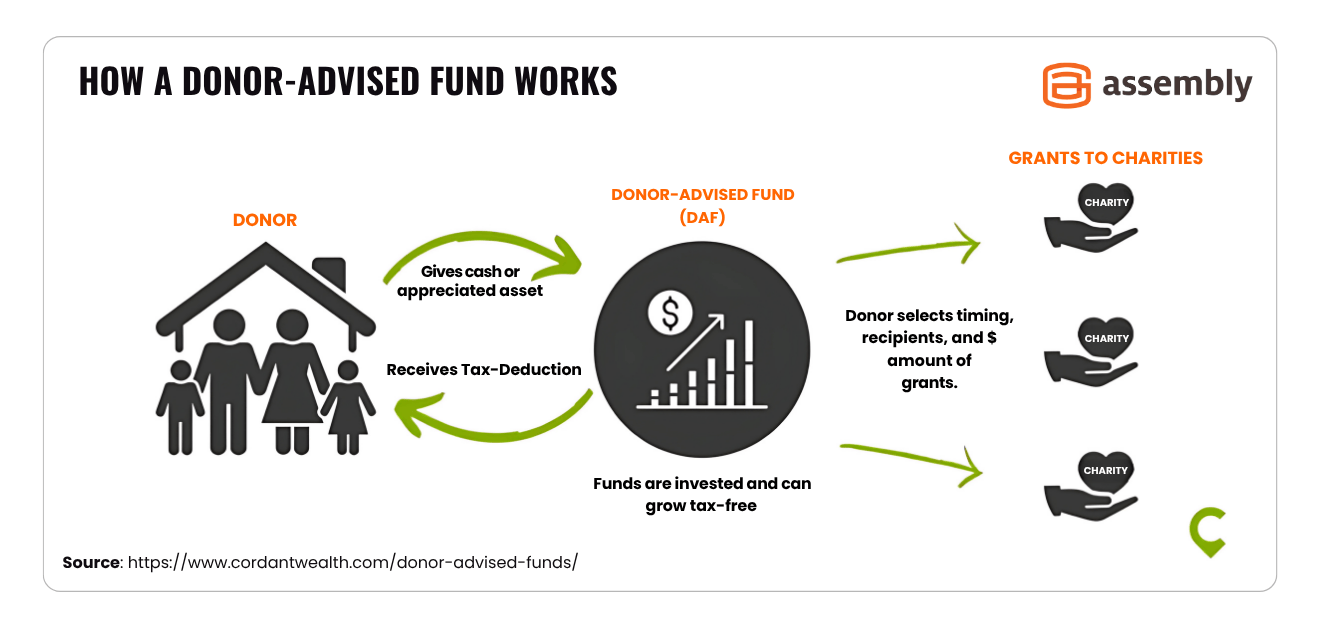
Donor-advised funds, also known as DAFs, are a popular way for caring and generous individuals to support nonprofit organizations while reducing their tax burden.
If learning more about donor-advised funds has been on your to-do list, read on. We’ll dig into the pros and cons of DAFs and how they differ from direct giving and QCDs.
If you already own a DAF, mark your calendar for October 8th, DAF Day 2026. DAF Day is an opportunity for donor-advised fund holders across the US to make a positive impact. More than $327 billion sits in DAF accounts waiting to be put to work.
A DAF is basically a charitable savings account. DAFs can be funded with cash, stock, or other assets and, over time, the account owner can make distributions to one or more nonprofit organizations.
DAFs are popular because they provide an immediate tax break, but account holders can distribute the funds at a later date. Distributions from a DAF are sometimes called “grants.”
When you contribute to a DAF, you generally receive an immediate charitable tax deduction for the amount of the contribution. The deduction is subject to IRS rules and applicable deduction limits. Other potential tax benefits of donor-advised funds include:
With direct giving, the charity receives the money right away. With a DAF, the account holder receives an immediate tax deduction, but charitable distributions can be made months or even years later.
IRA owners who are 70½ or older can make distributions directly from an IRA to a qualified charity without paying income tax. Anyone of any age can contribute to a DAF. Depending on your age, income and charitable goals, a DAF, a QCD or a combination of strategies may make sense.
Note: A QCD cannot fund a DAF. QCDs must go directly to a qualified nonprofit.
Contributions to a Donor-Advised Fund (DAF) reduce your tax liability right away and make a positive long-term difference. You can establish a donor-advised fund with:
After creating a DAF, you can continue to make contributions and enjoy tax benefits. Assets grow tax-free and you can also designate children or other heirs as your “successor advisors.” Establish a family tradition of generosity, or choose a charity to receive whatever remains in your DAF account when you pass.
There are two fairly minor drawbacks of using a DAF:
A DAF distribution can’t be used to pay for gala tickets, auction items or anything where you receive something in return. You can use a DAF to cover a paddle raise, support a capital campaign, or make any other financial contribution where you don’t receive anything beyond a thank-you note.
Speaking of which…some DAF holders are disappointed when they don’t receive a thank you after making a large contribution to their favorite charity. This is because DAF distributions are often anonymous. The charity receives a check or ACH deposit that simply has the name of a financial institution such as “Fidelity Charitable Giving.”
For those who prefer to donate anonymously, this is an advantage. But for those who like to be recognized or receive an impact report, you should contact the nonprofit and advise them of your DAF distribution. They’ll be glad to hear from you!
Simply opening a DAF doesn't guarantee that you are getting the most from it. The timing and type of assets you contribute can make your tax bill significantly smaller (or larger).
For example, one of our clients had two life insurance policies they no longer needed. We used the policies to establish a donor-advised fund, and the client:
Another client (before working with us) sold some low-basis stock and opened a DAF. Because they sold the stocks instead of donating the appreciated stock, the client had an unnecessarily large tax bill. As an Assembly client, we’re helping them plan future donations to be more tax-efficient.
As the example above illustrates, opening a DAF is only the beginning. A wealth manager can help you determine which assets to contribute, how much to give and when to make contributions based on your unique tax situation.
DAF Day is a national giving day similar to Giving Tuesday. It was created to encourage DAF holders to turn charitable intentions into action.
Whether you care about food insecurity, animal welfare, the arts or human rights, there’s a nonprofit that needs your support. Many organizations are doing the same work with smaller budgets, which means your contribution goes further right now than it would have two years ago.
Unfortunately, many DAF account holders fund their account, take the tax break and (for whatever reason), don’t distribute money to nonprofits. As of this article’s publication date, more than $327 billion earmarked for charities sits idle in donor-advised funds.
There is enormous potential for DAF account holders to bring about positive change. If you have a DAF account, mark your calendar for Thursday, October 8th, log in and send money to a charity in need. Imagine how amazing it will feel to get an enthusiastic “THANK YOU SO MUCH” from a nonprofit organization you care about.
Depending on where your DAF account is held, there are different ways to distribute funds. Before DAF Day, decide what nonprofit(s) you’d like to donate to and confirm how they can accept donations. Most will accept checks, but you may be able to transfer the funds electronically. If you don’t have a specific nonprofit in mind, we can provide a list of recommended organizations.
If you don’t have a DAF yet, there’s still time to set one up. Reduce your tax bill and support the causes you care about.
Contact us online for more information or give us a call at (415) 541-7774. We’re happy to answer any questions you may have.
Disclaimer:
Assembly Wealth (“Assembly”) is an SEC registered investment adviser; however, this does not imply any level of skill or training and no inference of such should be made. The opinions expressed herein are as of the date of publication and are provided for informational purposes only. Content will not be updated after publication and should not be considered current after the publication date. We provide historical content for transparency purposes only. All opinions are subject to change without notice and due to changes in the market or economic conditions may not necessarily come to pass. Mention of a security should not be considered a recommendation or solicitation to purchase or sell the security, and any securities mentioned may be held by Assembly for client portfolios.
The client example above reflects the experience of a particular client and is provided for illustrative purposes only. Estate planning strategies and the resulting tax or probate savings depend on each client's unique financial circumstances, applicable law, and individual objectives. There is no guarantee that other clients will achieve similar results.
This material has been prepared for informational purposes only, and is not intended to provide, and should not be relied on for, tax, legal or accounting advice. You should consult your own tax, legal and accounting advisors before engaging in any transaction.
Information presented represents an opinion as of the date published and should not be considered an investment recommendation. Assembly does not become a fiduciary to any listener, reader or other person or entity by the person’s use of or access to the material. The reader assumes the responsibility of evaluating the merits and risks associated with the use of any information or other content and for any decisions based on such content.